10 Best Trade Show Display Items for Busy Teams
Posted by Promo On Demand on 16th Nov 2026
A trade show floor gives you only a few seconds to earn a second look. Your stand needs to identify your brand, explain why visitors should stop and give your team the confidence to start useful conversations. The best trade show display items do not simply fill a booth. They make your presence clear, credible and easy to remember.
For Australian businesses, the right mix depends on the venue, audience, stand size and event objective. A compact industry expo needs a different setup to a major conference or outdoor field day. The strongest display plan starts with what your team needs to achieve, then selects items that work together rather than competing for attention.
Best trade show display items to build a stronger stand
1. Branded pull-up banners
Pull-up banners remain one of the most practical display investments for exhibitions, conferences and in-store activations. They travel easily, set up in minutes and give your stand a clear visual anchor. A well-designed banner should communicate one core message from several metres away: who you are, what you offer and why it matters.
Avoid trying to turn a banner into a brochure. Large logo placement, a concise headline and a strong visual will usually outperform small blocks of copy. For teams attending multiple events, banners designed around enduring brand messages offer better long-term value than campaign-specific artwork that dates quickly.
2. Branded tablecloths and fitted table covers
A standard trestle table can look temporary. A fitted branded table cover immediately makes it part of your stand. It also creates useful concealed storage for stock, personal bags, spare collateral and technology, helping the space stay organised during a busy day.
Choose a colour that supports your logo and makes it visible across a crowded room. Darker colours can be more forgiving at high-traffic public events, while a bright brand colour can work well when your stand needs to cut through a neutral exhibition hall. The trade-off is practical: a louder colour earns attention, but it should not overpower the product or message on display.
3. Modular media walls and fabric backdrops
If you have a shell scheme or a larger footprint, a media wall creates the visual impact that a pull-up banner cannot. Fabric backdrops and modular display systems provide a polished background for product demonstrations, photography, meetings and social content. They are particularly effective when your team needs a stand to look consistent from every angle.
This is where production quality matters. Artwork needs to account for scale, panel joins, lighting and viewing distance. A high-resolution image that looks sharp on a laptop can appear soft when printed across a three-metre wall. Plan artwork early and request a proof before production so brand colours, logo placement and copy are right before the event deadline closes in.
4. Custom flags and outdoor signage
Outdoor events, field days and sporting activations call for display items that work in wind, open space and changing weather. Teardrop flags, feather flags and durable outdoor banners help people locate your site before they reach it. They are useful where exhibition stands are spread across a large venue or where vehicle and foot traffic approach from different directions.
Check the organiser's rules before ordering. Some venues restrict flag heights, weighted bases or placement near walkways. It is also worth selecting hardware designed for the conditions. The cheapest option is rarely the best option if it is unstable, difficult to transport or unsuitable for repeated use.
5. Product display plinths and counter units
When the product itself is central to the conversation, display plinths, branded counters and retail-style stands give it a proper stage. They are ideal for samples, prototypes, technology, cosmetics, food products and premium corporate gifts. A counter also gives staff a natural place to greet visitors, capture details or demonstrate an offer.
Keep the surface disciplined. One hero product, a clear call to action and the tools your team needs are often enough. A counter crowded with every available sample can confuse visitors and make premium products feel less considered.
6. Printed brochures, catalogues and capability cards
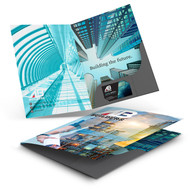
Digital lead capture is valuable, but print still earns its place at a trade show. A concise capability brochure or product card gives a visitor something useful to take back to the office, especially when decisions involve several stakeholders. It should answer the questions that arise after the event: what do you provide, who do you work with and what should happen next?
The format should match the sales cycle. A one-page capability sheet works well for high-volume lead generation, while a more detailed catalogue may suit a buyer comparing product ranges or service packages. Print only what your team can distribute purposefully. Boxes of leftover brochures are not proof of a successful event.
7. Branded uniforms and staff apparel
Your people are part of the display. Matching polos, shirts, jackets or aprons help visitors quickly identify who can help, while presenting a more coordinated and professional team. Apparel is particularly valuable when staff rotate through a stand, work a large activation or support an outdoor event.
Comfort is as important as presentation. Consider the venue temperature, physical activity and event duration before choosing garments. A premium embroidered jacket may suit a winter trade event, while breathable polos are a more sensible choice for a packed convention centre or summer activation. Name badges can add a more personal touch where conversation is central to the sales process.
8. Branded giveaways with a job to do
Giveaways work best when they are useful, relevant and easy to carry. Reusable drinkware, notebooks, pens, tote bags, charging accessories and health-focused items can keep your brand in view after the event, but only if they suit the audience. A procurement audience may value a quality notebook and pen; a wellness expo may respond better to a reusable bottle or cooling towel.
Quality carries a message. A giveaway that fails quickly or feels disposable can weaken the premium impression created by your stand. Rather than ordering the largest possible volume, consider a tiered approach: a practical item for general visitors and a higher-value gift for qualified prospects, client meetings or booked demonstrations.
9. Lead capture tools and QR-enabled signage
Trade show success is not measured by foot traffic alone. The value is in what happens after the event. QR signage can direct visitors to a landing page, competition, catalogue, appointment booking or product demonstration. Tablets and simple lead forms can help staff record conversation notes while details are fresh.
Do not make technology a barrier. If the Wi-Fi is unreliable or the form takes too long, your team will stop using it. Build a simple backup process and agree on the information that genuinely matters. A qualified lead with clear notes on timing, need and next step is more valuable than a long list of names with no context.
10. Merchandise packs for meetings and follow-up
A trade show does not end when the doors close. Curated merchandise packs can support pre-booked meetings, post-event follow-up and internal sales activity. A considered pack might combine a useful branded item, a campaign card and a product sample, presented in packaging that reflects your brand standard.
This approach is especially effective for longer B2B sales cycles, where a well-timed physical touchpoint can keep your business front of mind. It also allows marketing and sales teams to use the event investment beyond the stand itself.
How to choose the right mix for your event
Start with the visitor journey. From a distance, they need to recognise your brand and understand the broad offer. At the stand, they need a reason to engage. After the conversation, they need an easy way to remember you and take the next step. Your display items should support each stage.
Budget should be split between reusable assets and event-specific materials. A media wall, table cover, banners and staff apparel can serve many events when designed well. Campaign cards, targeted giveaways and QR signage can change from one activation to the next. This balance gives you consistency without making every stand feel repetitive.
Operational detail also deserves attention. Confirm production lead times, artwork requirements, venue access, bump-in windows, freight arrangements and storage before placing an order. A premium display that arrives late or cannot fit in the allocated space is not a premium outcome. Working with one supplier across signage, apparel, print and merchandise can reduce those handovers and make brand consistency easier to manage.
The right display is not necessarily the biggest or most expensive one. It is the one that gives your team a professional platform to have better conversations. Promo On Demand helps businesses bring those elements together with branded merchandise, event display and dependable production support, so every item has a clear role on the floor and after it.